
What zinc concentration in teeth reveals
It could influence whether a dentist recommends low or high zinc-containing materials during treatment.
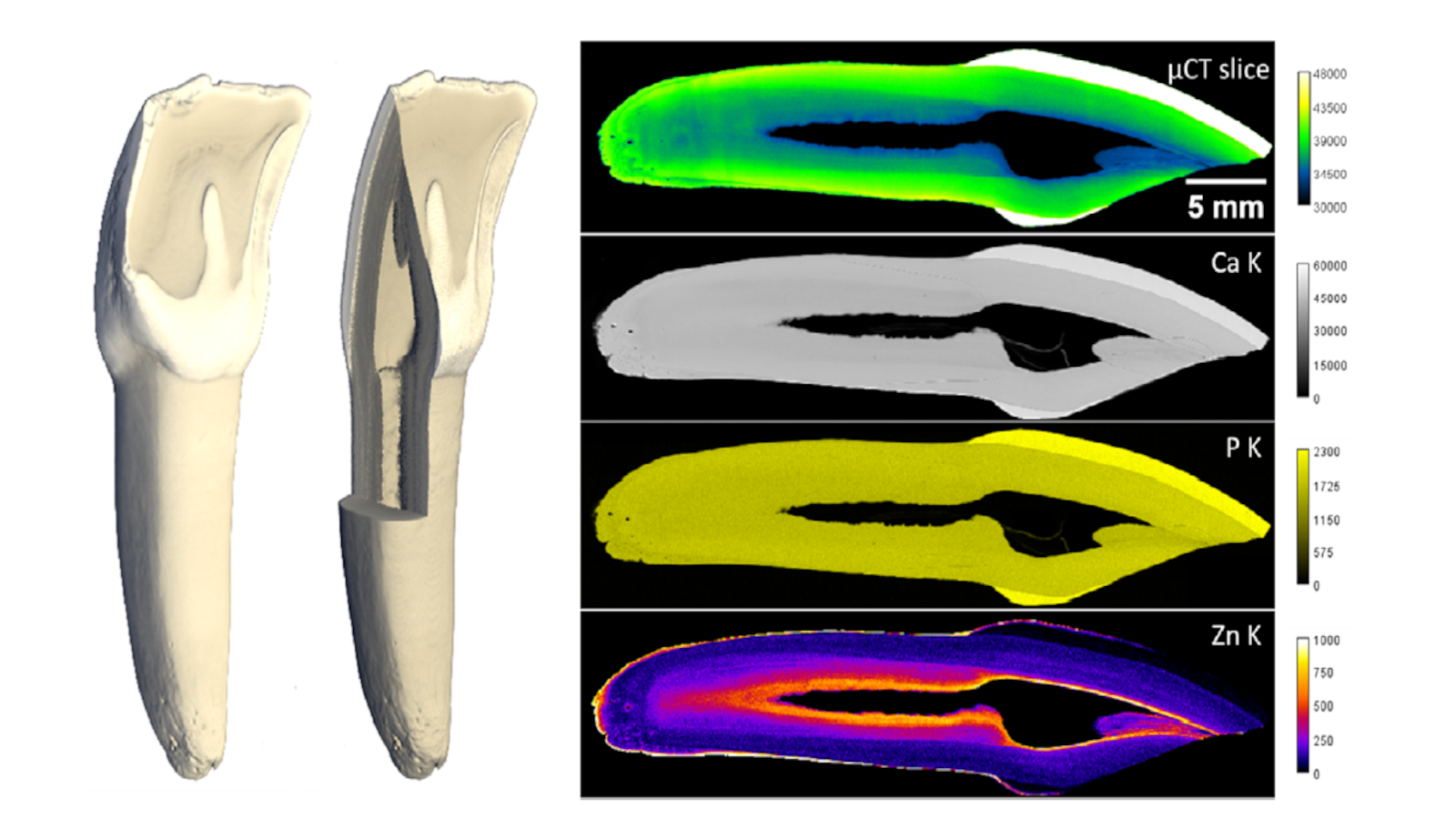
The distribution of natural zinc along and across teeth in three dimensions has been charted by a trio of German research institutions, Charité Berlin, TU Berlin and HZB.
Using complementary microscopy imaging techniques the researchers found that as porosity in dentine increases towards the pulp, zinc concentration increases 5~10 fold. They said the results help understand the influence of widely-used zinc-containing biomaterials (e.g. filling) and could inspire improvements in dental medicine.
First, they made fine cuts in the teeth and examined them under a scanning electron microscope. The images revealed that the material between the individual tubules was almost perfectly homogeneous. The team then examined the teeth using different dental and industrial 3D X-ray tomography systems to map their three-dimensional microstructure, in particular density.
As expected, tooth density decreases near the pulp, corresponding to an increase in tubules. These findings made it possible to model the material correctly and evaluate the experimental data from maps of micro-X-ray fluorescence spectroscopy.
The team recorded the signals from many elements, in particular calcium, phosphorus and zinc. While calcium and phosphorus, both of which originate from the nanocrystals of dentine, are distributed evenly, they observed and quantified a very sharp increase in the zinc concentration from the outside to the inside, i.e. towards the pulp.
“These results are very helpful for the further improvement of dental care, for example whether the dentist should recommend low or high zinc containing materials during treatment,” said Professor Paul Zaslansky, of Charité Berlin.
In healthy teeth, zinc is enclosed in the dentine. However, contact with acids, whether through caries or through root canal treatment with zinc-containing pastes, could potentially chemically activate enzymes, with possible negative effects.
The study shows that zinc could serve as a good proxy to determining bony-material mineral density. “Bone density is a huge concern for many patients; everyone knows that we want calcium and more mineral for bones to be strong. But actually, maybe what we want is a good balance of micro porosity?” suggested Professor Zaslansky.
“We find, unexpectedly, that zinc can likely be used as a very sensitive measure of gradients in material density, which may change over the lifetime. Density is linked to mechanical competence of bony tissues, and should neither be too high or too low, to serve in the human body. With high sensitivity methods such as X-ray fluorescence, we may be able to take samples and monitor density changes with ageing, for example due to use of well-chosen dental fillings or oral pastes.”
The team used discarded cattle teeth as discarded human teeth are usually contaminated with zinc from treatment or toothpaste. “Studies on human teeth are needed to confirm our bovine-tooth based hypothesis,” said Professor Zalansky.