

First case of a tooth growing out of an eye socket
Boy noticed a painless swelling for about a month, but was only taken to hospital when two whitish points began poking through
A 16-year-old boy in India has had a tooth removed from his left eye socket, between the eyelid and the eyebrow.
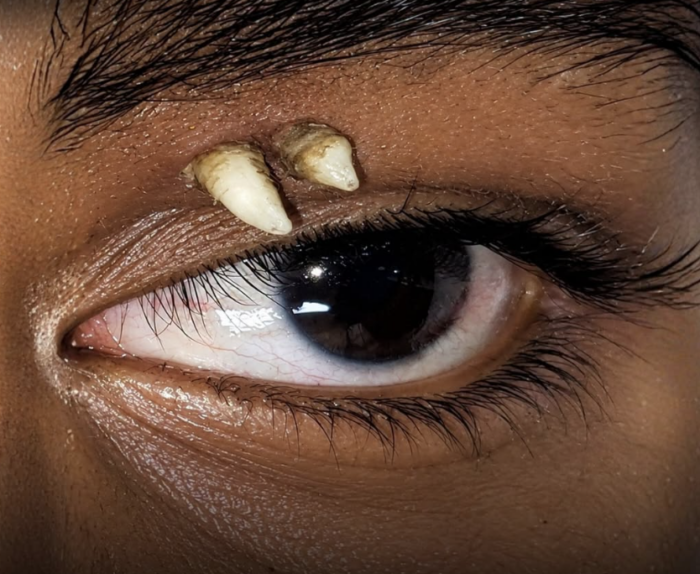
The boy had noticed a painless swelling for about a month, but was only taken to hospital when two hard, whitish points began poking through, reported The Conversation. A scan revealed a fully formed canine tooth; an extremely unusual example of an ectopic tooth.
Ectopic teeth are teeth that develop or erupt in the wrong place. Instead of following the usual path to the mouth, they end up somewhere else. They can be normal baby or adult teeth, or sometimes extra teeth known as supernumerary teeth.
Ectopic teeth are most often found in the maxillary sinus – the hollow space behind the cheekbone – but they have also been found in the nasal cavity, palate, chin and jaw joint. A review of 61 published cases found that they can go unnoticed for years or cause pain, swelling, headaches or difficulty opening the mouth. A tooth growing inside the nose can lead to a blocked nose, discharge and nosebleeds.
How does a tooth end up somewhere as strange as an eye socket? The face develops from several groups of cells and tissues that move and join together in the womb. Tooth development depends on interactions between some of these tissues. If this process goes awry, a tooth can sometimes develop in an abnormal location.
Developmental problems are not the only possible explanation. A review of ectopic teeth in the upper jaw also lists injuries, dental treatment and growths such as cysts and tumours as possible causes.
Having several extra teeth can sometimes be a sign of an inherited condition. One example is cleidocranial dysplasia, a rare genetic disorder that affects the development of bones and teeth. Other much rarer genetic conditions have also been linked to extra teeth.
The Indian teenager had no history of trauma, and doctors could not determine why teeth had developed in his eye socket.
Whether an ectopic tooth needs removing depends on where it is and whether it is causing problems. An isolated tooth with no symptoms can sometimes just be monitored, but it may need to be removed if it causes an infection, blocks a passage, damages nearby structures or is linked to a cyst.
Doctors use scans to pinpoint the tooth and see what lies close to it. A CT scan can show whether it sits near the eyes, nerves or blood vessels, which helps them decide whether to operate.
Surgery ranges from a simple extraction to a complex operation. For teeth in the nose or sinuses, surgeons can often use an endoscope – a thin tube with a camera and surgical instruments on the end – to remove them through the nostrils rather than making a larger cut. A review identified 27 published cases in which ectopic teeth in the nose or sinuses were removed this way.