
The MalDent Project
Building the oral healthcare workforce and access to Improved oral health for all Malawians
Malawi is one of the six poorest countries in the world, with average per capita income of $550. Eighty percent of its 22 million citizens live in rural areas, surviving on subsistence farming which is susceptible to climate change. Food insecurity is common and 70% live below the poverty line. The median age of the population is 18.4 years.
The Ministry of Health budget cannot cover the multiple needs of the population, and historically up to 55% of total health expenditure has been from external donors. Not surprisingly, oral health and dental care services have been neglected in Malawi.
Against this backdrop, The MalDent Project was established in 2018, following an approach from the University of Malawi College of Medicine (now Kamuzu University of Health Sciences [KUHeS]) to the University of Glasgow (UofG). Funded by the Scottish Government (£1.6m), Borrow Foundation ($75k) and the World Bank ($5.2m), this Scotland / Malawi university partnership is addressing the challenges, with a focus on building the workforce (40 dentists and 100 dental therapists for 18 million people in 2018) and establishing an oral health policy framework.
Development of the BDS curriculum commenced in 2017, with international input from Scotland, South Africa and the USA. The Department of Oral Health Sciences was established within the Faculty of Medicine to deliver the BDS course. The curriculum was approved by the University of Malawi Senate in March 2019, with the first students enrolling in August of that year. Staff recruitment and training were aided by the World Bank, and suitable interim clinical teaching facilities created in two central hospitals through collaborative working with the charity Dentaid and commercial partner Henry Schein Dental.
All members of that initial cohort of BDS students graduated as Malawi’s first home-trained dentists in April 2025. They have now completed their internships in central hospital dental departments and are fully registered with the Medical Council of Malawi. The second cohort of BDS students has recently completed the course, and these two groups of young professionals have effectively increased the country’s dental surgeon workforce by 50%. There are currently 179 students enrolled on the BDS programme, providing a consistent pipeline of new dentists for Malawi.
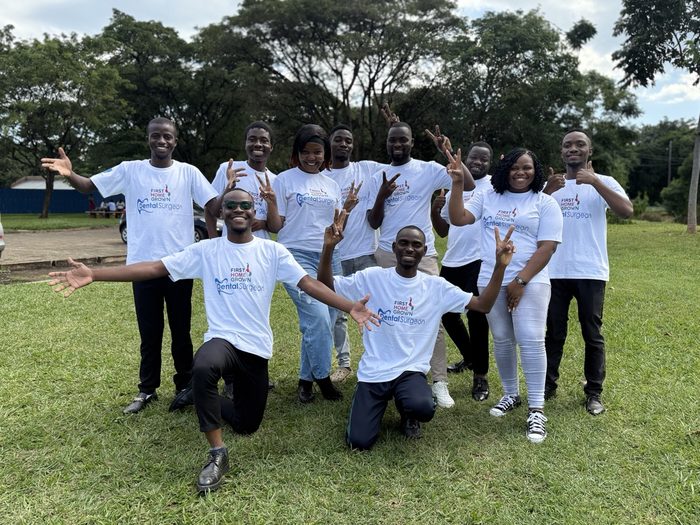
In 2024, two Final Year dental students from KUHeS visited Glasgow for an elective visit, generously sponsored by the HOPE Foundation of the Royal College of Physicians & Surgeons of Glasgow (RCPSG). Very recently, the Executive of the RCPSG Dental Faculty has agreed to fund a visit to Glasgow each year for the next five years by two dental interns from Malawi. The RCPSG has been a strong and loyal partner of The MalDent Project, for which we are very grateful.
Identifying and appointing clinical academic staff has been a challenge because of the paucity of dentists within Malawi, none of whom have teaching or research experience. Dental academics from overseas are reluctant to accept posts because of the level of remuneration and other terms and conditions. However, with the emergence of the new graduates from the course at KUHeS, there is now an opportunity to recruit at a junior level and develop the academic skills of these young Malawian dentists within post. That process is now underway and mimics the mechanism used when KUHeS launched its physiotherapy programme over ten years ago.
Since the inception of The MalDent Project, additional support for the Department of Oral Health Sciences at KUHeS has been provided via periods of intensive hands-on teaching delivered by visiting UK faculty from the Universities of Glasgow, Aberdeen, Liverpool, and Newcastle and South African faculty from the University of Western Cape. Each visit includes up to six visiting academics for a period of typically one week, funded by the Scottish Government. In addition, on-line teaching has been provided from a variety of international academic centres. This support is deemed critical until a full staffing complement is in place.
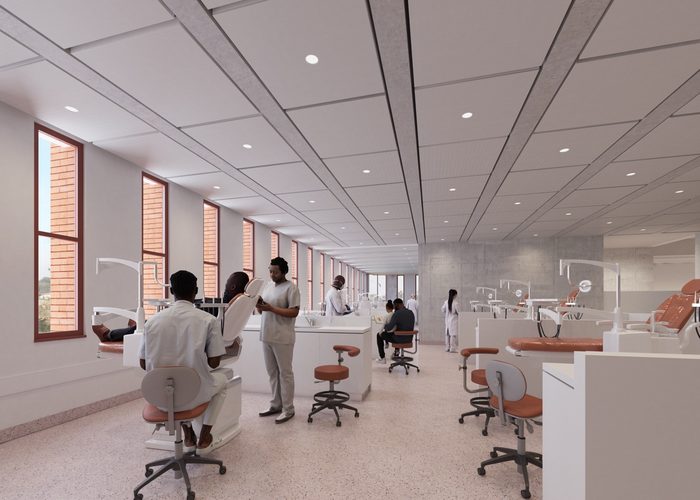
Construction of a purpose-built dental teaching building for KUHeS, designed using Scottish Government funding, is now underway. The cost of construction is being covered by the World Bank through its ‘Skills for a Vibrant Economy’ programme. The design of the building and supervision of its construction has been led by John McAslan + Partners, working with a Malawian team of architects, engineers and surveyors. The structure also incorporates generic teaching space, including a lecture theatre, resuscitation training facility, computer cluster, meeting rooms and offices, which will increase capacity on the campus for those on other healthcare courses such as medicine, pharmacy and physiotherapy.
As a second and integral component of The MalDent Project, Malawi’s first National Oral Health Policy was created by a Ministry of Health-led multi-sectoral Task Force, with input from the UofG, KUHeS and WHO AFRO. The policy was launched in 2022, with a focus on prevention but recognition of the need to improve access to curative services. A follow-up national workshop held in Lilongwe later that year, delivered a detailed implementation plan which aims for closer integration of oral health into the wider workforce, services and structures.
Child oral health improvement in Malawi is a major focus of policy implementation. Malawi’s first National Child Oral Health Survey was undertaken in 2023 as a joint activity between KUHeS, the UofG, the Ministry of Health and the Scottish charity Smileawi. Almost 50% of 6-year-olds and 25% of 12-year-olds had dental caries into dentine, but none of the 2941 children examined had received treatment.
The data were presented at a workshop in Mponela in 2024, funded by the Borrow Foundation. This included representation from the Ministries of Health and Education and resulted in establishment of a multi-sectoral Task Force to develop a National Child Oral Health Improvement Plan for Malawi, based upon principles of Scotland’s evidence-based Childsmile programme. This includes plans for greater integration of oral health into primary care child surveillance and the school health agenda (WASH/nutrition).
In August 2026, Anna Smith, who had recently gained her BDS degree from the University of Birmingham, collaborated with five senior dental students from KUHeS at a school in Chilomoni, just outside Blantyre City. The team worked with staff and the children there to co-design a supervised toothbrushing programme. The project proved that logistically such programmes can be established effectively, but the challenge is identifying a source of affordable fluoride toothpaste. This problem affects many developing countries, especially in sub-Saharan Africa, and a multi-lateral approach is required to overcome it.
Whilst establishing a BDS degree programme was the initial focus of The MalDent Project, the longer term aim is to establish the Department of Oral Health Sciences as a research-led academic unit and, eventually, a Dental School in its own right. Work is now underway to build research collaborations between key departments at KUHeS and the UofG, with a focus on epidemiology, public health and inflammation biology.
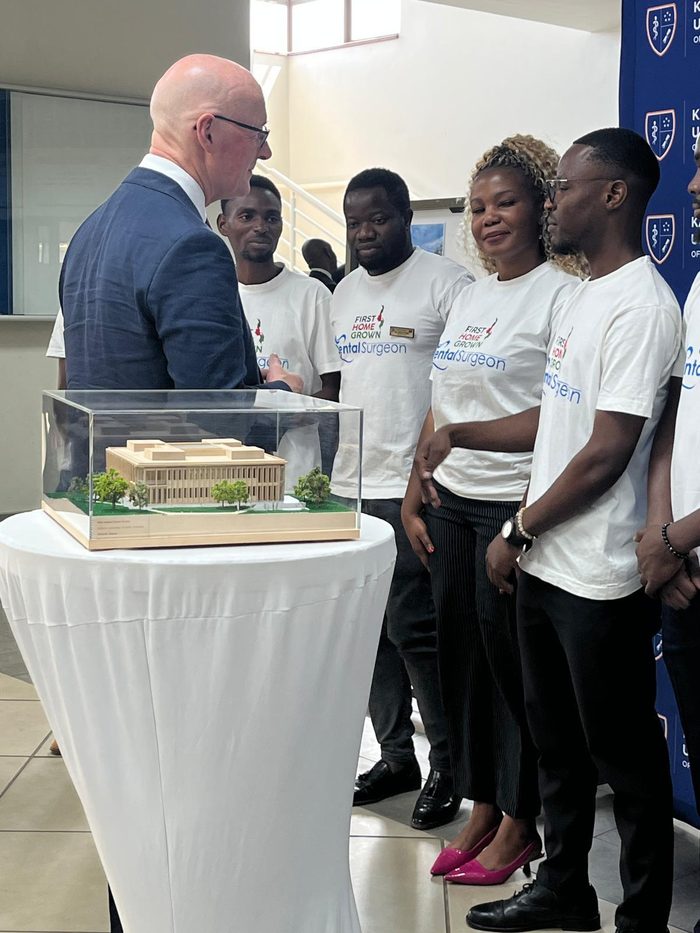
In October 2025 Scotland’s First Minister, John Swinney MSP, travelled to Malawi and Zambia to view projects that have been funded by Scottish Government International Development.
During his time in Malawi, he was able to visit KUHeS, meet the first group of BDS graduates and be informed about the new building under construction.
Without the core funding from the Scottish Government, awarded in 2018, it would have been impossible for The MalDent Project to launch and so it was very fitting that the First Minister saw at first hand the progress that has been made.
Achievements to date, and ongoing activities, are heavily reliant on donor funding. Key to long-term sustainability will be Malawi Government commitment, but in a country whose public debt stood at 82.1% of GDP in 2023, investment in oral health as an integral part of the non-communicable disease agenda will be a continuing political challenge and require strong advocacy.