

Space agency and Scottish university partner in a 400 mile checkup via satellite
Dental examination run using a secure satellite link and portable 5G cellular system
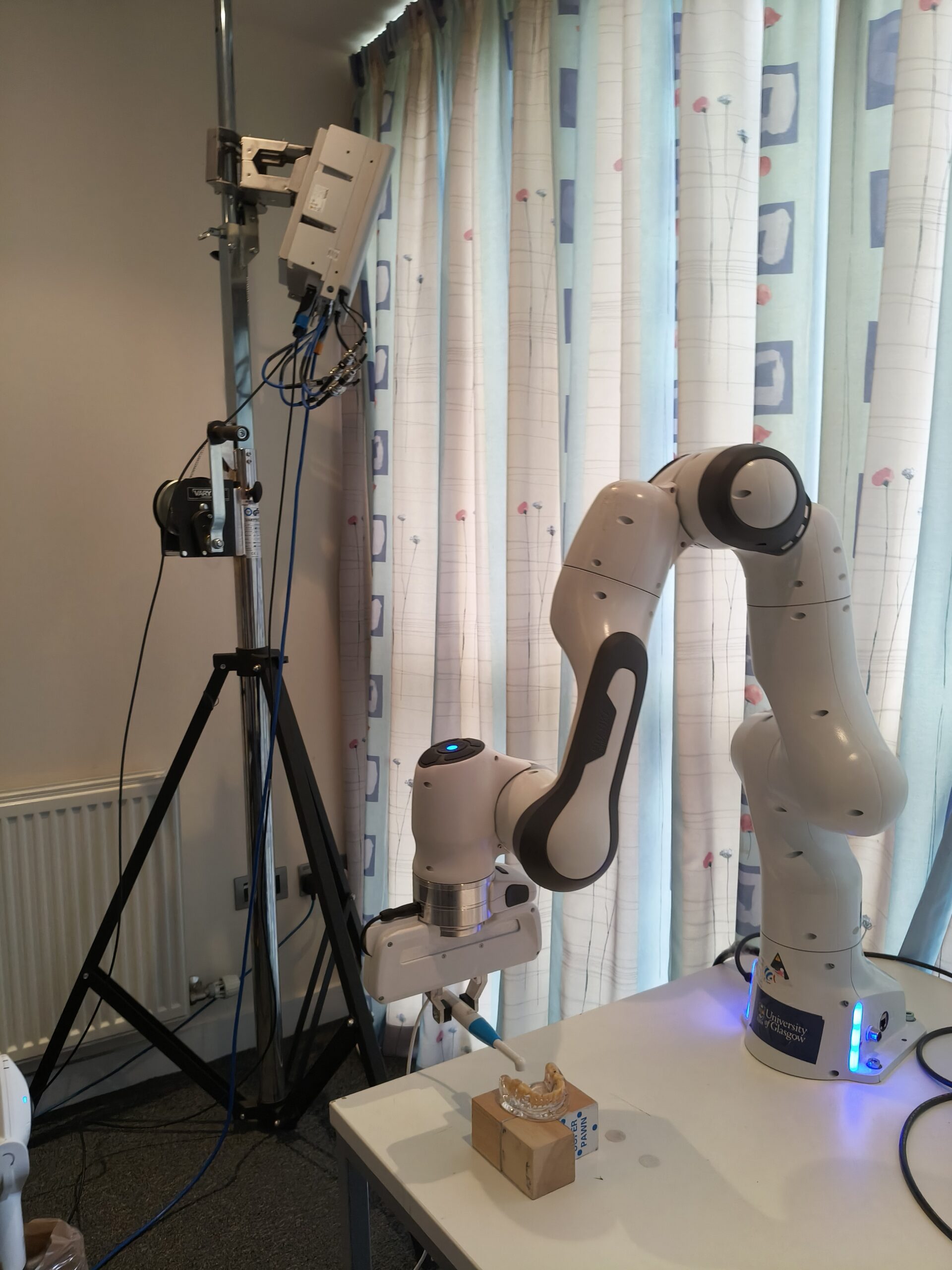
Robotic arm running a dental inspection on a simulated patient at the Scottish Centre for Ecology and the Natural Environment. Picture: University of Glasgow
People living in remote areas could one day receive specialist medical care without leaving their communities, thanks to advances in telemedicine through satellite communications.
The European Space Agency (ESA) and the University of Glasgow have successfully run a remote dental examination using a secure satellite link combined with a portable 5G cellular system.
During the test, a dentist working from ESA’s European Centre for Space Applications and Telecommunications (ECSAT) in Harwell conducted a full dental inspection of a simulated patient located more than 400 miles away at Glasgow’s University’s Scottish Centre for Ecology and the Natural Environment facility on Loch Lomond.
The dentist operated a robotic arm in real time through a hybrid satellite‑and‑5G connection. Once the examination was complete, the team dispatched a drone to deliver medication to the ‘patient’. The drone was monitored using a 5G‑enabled tracking system, showing how multiple technologies can work together to support timely care.
The demonstration was part of ESA’s 5G REMOTE project, which aims to bridge the gap between satellites and portable 5G networks for communications. The pop‑up network used in the demonstration can be used wherever satellite coverage reaches, providing high‑quality connectivity that enables advanced telemedicine services.
The simulation was carried out through collaboration between ESA’s Connectivity and Secure Communications Directorate and the Glasgow Next‑Generation (GXG) testbed at Glasgow University.
“Access to healthcare should not depend on postcode,” said Professor Muhammad Imran, Head of the university’s James Watt School of Engineering. “Our team’s work with ESA demonstrates a practical pathway to bring specialist assessment and timely intervention closer to remote and rural communities.”
Comments are closed here.