

Why change anything?

Dental implants have been used to replace missing teeth for more than 60 years. The shape of implant threads, external design and fixation elements are still changing and evolving over time to improve integration with the jawbone and soft tissues. The classic dental implant placement protocol was introduced in the 1960s by Per-Ingvar Brånemark and involved delayed implant placement.
Since then, we have progressed from delayed placement to immediate post-extraction placement with immediate loading. Naturally, freehand (or eye-guided) implant placement will be replaced by computer-assisted implant surgery, as this allows us to provide accurate, pre-planned implant placement using prefabricated prosthetics prepared in advance of the surgery.
Just like in everyday life there are people who are sceptical of electric cars and will always find a million reasons not to buy one, the same exists in the dental community. There are clinicians who believe guided implantology is not necessary for them; because they have been operating for five, 10, or 20 years, their complication rate is below 5%, and they ask: “Why should I change anything?”
The answer is simple. If you only have a few years of practice left, then do not waste your energy; continue working with your proven method. But if you have not yet reached the midpoint of your career, I want to encourage you to catch up with those already using this highly advanced, treatment-enhancing method.
I placed my first dental implant back in 2005. Over the past 20 years, I have built a strong foundation in surgical techniques, handling a wide range of clinical situations, from single implants to full-arch cases. I have consistently achieved very stable peri-implant bone levels; the kind of outcomes we used to call ‘zero bone loss’. For many years, I approached implant placement entirely using the traditional freehand method.
Like many experienced clinicians, I was sceptical about guided surgery. I saw it as something useful for beginners or those with limited surgical confidence. But I was wrong. That perspective changed shortly after the COVID disruption, when I introduced guided surgery into my daily workflow. I extend my sincere thanks to my colleague, whose support and guidance were invaluable throughout my transition into guided implantology.
Now, looking back, I can confidently say: adopting guided surgery was one of the best clinical decisions I have made. If I could turn back the clock, I would have embraced it much sooner. Guided surgery is not about replacing surgical skill; it is about enhancing precision, improving prosthetic outcomes and creating a more predictable workflow, especially when working on full-arch immediate loading cases.
Why should I choose guided implant surgery over freehand?
Here are, in my opinion, some of the most important and indisputable indications:
- When high precision is required near critical anatomical structures; IAN, mental foramina, arterial branches, or atypical alveolar anatomy
- When inter-root distance requires extreme accuracy and parallelism to maintain safe distances and prevent root damage
- When aiming to avoid sinus lift procedures (due to pathology or patient preference) and maximise available alveolar height using non-standard/odd angulations
- For immediate placement cases where optimal implant positioning is crucial, whether in posterior or anterior regions
- When planning immediate loading with fixed partial or full-arch restoration
- When aiming for minimally invasive flapless procedures to reduce postoperative discomfort
- When working with porous bone and aiming to avoid “spinners” while achieving good primary stability
- In complex cases, e.g. full-arch rehabilitation involving extraction of non-restorable teeth (terminal dentition – this term itself deserves more open discussion within our dental community), alveolar ridge reduction and immediate full-arch restoration
- When placing orthodontic palatal implants
- When preparing a site for tooth auto-transplantation
Once you decide to step into (static) guided implantology, you will need a high-resolution CBCT, an intraoral scanner with high-quality scans, computer-aided design software, a 3D printer and a guided surgical kit of the implant system you are familiar with.
The most critical step in achieving the pre-planned outcome is transferring the virtually planned implant position from the software to the patient’s mouth. I strongly recommend being actively involved in all stages of guide planning; from implant positioning and adoption of prosthetic components to selection of guide support teeth (and/or fixation pins) and designing the guide itself.
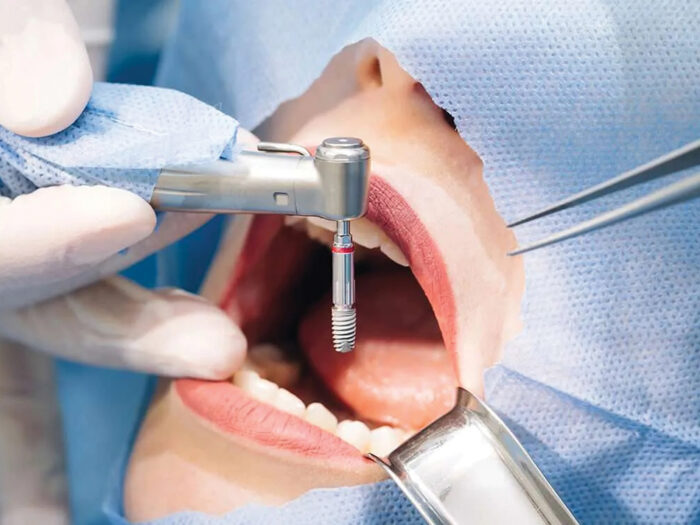
is the most appropriate. Only after the operation, the dentist can see if the positioning of the implant is good
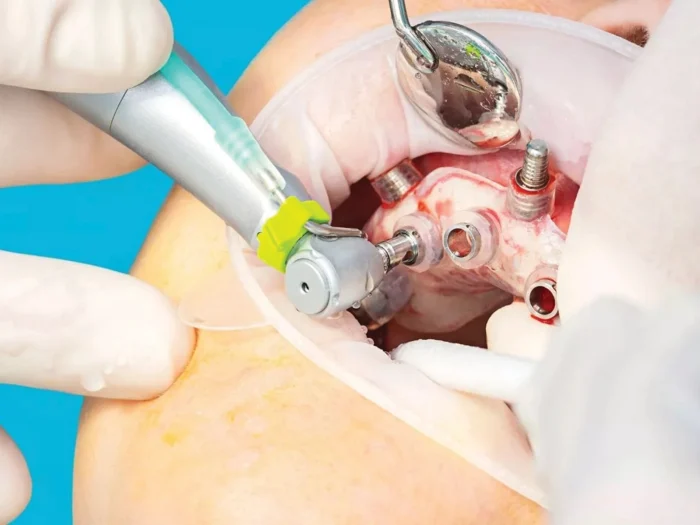
The accuracy of implant placement with static guided surgery depends on multiple factors. The three main groups of potential errors are:
- During image acquisition (CBCT, surface/dental registration, guide manufacturing)
- Related to the type of guide support (tooth-supported guides are most accurate; bone-supported are the least accurate)
- During the surgical procedure (surgeon-related).
The precision of guided surgery depends on the accumulation of all these factors, from scanning to final implant insertion. The main concern remains the deviation (coronal, apical and angular) between planned and actual implant positions. These deviations are well documented, and here are my tips to minimise them:
- Find an experienced mentor (preferably a clinician rather than dental technician at the beginning) who can guide you from planning to analysis of the surgical results.
- High-quality intraoral scans and properly processed CBCT data to reduce planning improvisation.
- Careful selection of support teeth for guide fixation, minimising time between scan and surgery. Remember that mobile teeth may shift; always use the most recent scan in complex cases.
- Design bilateral tooth-supported guides rather than unilateral; avoid starting with gum- or bone-supported guided; build confidence gradually.
- After seating the guide, verify its fit; use perforation windows and consider printing guides in transparent resin.
- Choose higher sleeves when possible, to reduce apical deviation and prefer metal sleeves over sleeveless guides.
- Always maintain safe distances when planning near teeth or between implants as later components may not fit.
- Choose an implant system that allow easier handling, especially in posterior regions where space is limited; we are not treating crocodiles.
- Always have a Plan B in case the guide does not fit or fractures during surgery.
Comments are closed here.