

Dental Connect

Community engagement is a fundamental aspect of preventative dentistry, offering opportunities to promote oral health awareness and education beyond the clinical setting.
As part of our involvement with Dental Connect, a Dundee Dental School initiative focused on improving oral health within the Dundee and Tayside community, we organised and delivered a family-orientated outreach event at the Boomerang Community Hub1 in Dundee on 4 April.
The event was organised through collaboration with community event leader Alison Carr from the Boomerang Community Hub, alongside several students who had been appropriately trained to deliver curated resources to the public. Part of this organisation process involved liaison with members of the Dental Connect committee to ensure that adequate supplies were available for the anticipated quantity of visiting public.
This outreach initiative was a rewarding experience that demonstrated the impact of preventive education within the community
The event was designed as a spring-themed session aimed at engaging families in oral health education through interactive learning. Three stations were developed to facilitate this: an oral hygiene and dental trauma education station, a dietary advice station, and a “dress as a dentist” activity. The latter encouraged children to role-play using colourful scrubs, gloves and glasses, creating a relaxed and enjoyable environment in which interactive learning could take place, forming a positive attitude towards dentistry (Figure 1).
The trauma station
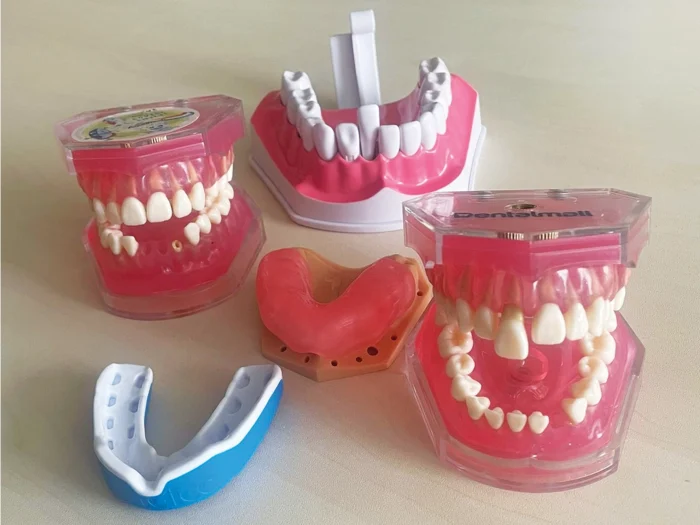
The trauma station focused on two main topics: prevention of tooth avulsion and management of permanent tooth avulsion. Delivery of this information was aided through use of a ‘Pick it, Lick it, Stick it’ educational poster provided by Dental Trauma UK.2 Further discussion with participants included the use of milk as an appropriate storage medium where immediate re-implantation of the avulsed tooth is not possible. All advice given was in accordance with current International Association of Dental Trauma guidelines and Dental Trauma UK resources.2,3 A mixture of dentate models with removable teeth and mouthguards were used at this station to further participants’ understanding (Figure 2).
The oral hygiene station
Toothbrushing technique and frequency were the main topics discussed at the oral hygiene station which aimed to improve participant knowledge and to instil beneficial habits from a young age.
Individuals were queried on their existing knowledge of the following questions: do they know the recommended frequency and duration of toothbrushing each day, and could they demonstrate their current technique using a large dentate model and toothbrush? Following this, students demonstrated and explained the Bass technique using the same dentate model and toothbrush. Dentate puppets were also used for children to demonstrate their understanding after receiving instruction, with this practical aspect allowing for immediate correction to improve execution (Figure 3).
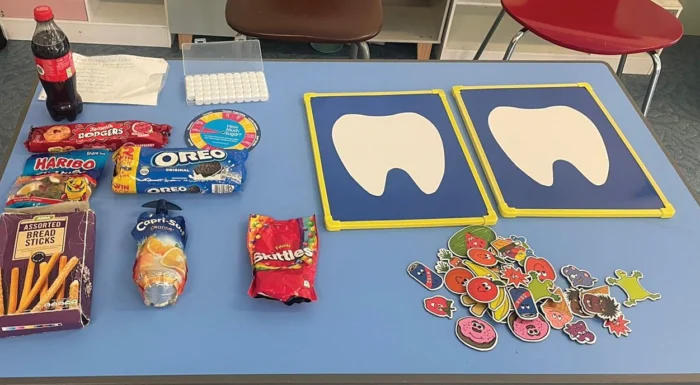
Within the dietary advice station (Figure 4), there were again two focuses: to identify foods which are ‘friendly’ and ‘non-friendly’ to the dentition, as well as to educate on the sugar content of common food and drink through visualisation with plastic resembling sugar cubes. Through this, students were able to discuss the importance of reduced snacking and restricting soft drinks to mealtimes, illustrating the potential negative effects on oral health.
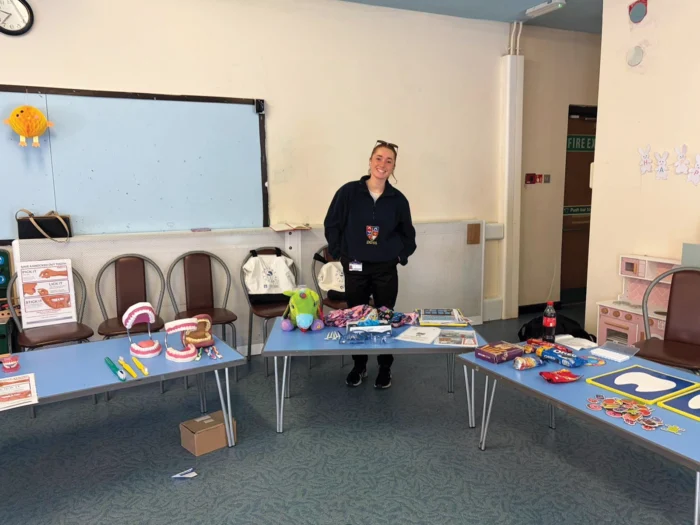
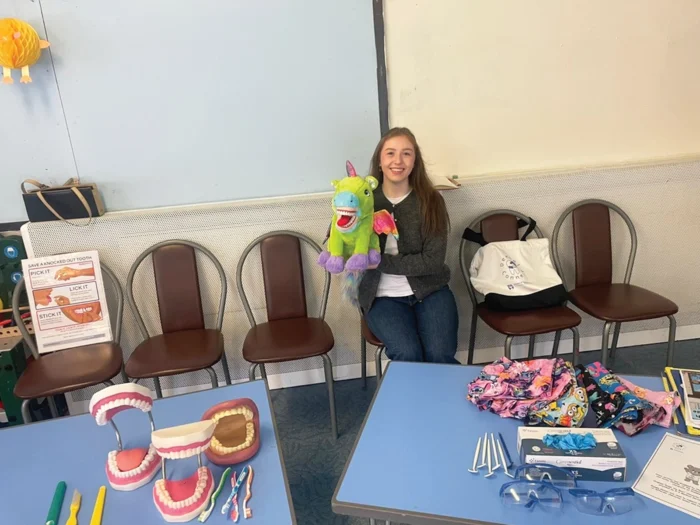
Dentate models
and unicorn puppet used to administer toothbrushing instruction (featuring Rachel McLeod)
The ‘dress as a dentist’ station
We found that the younger attendees especially enjoyed the ‘dress as a dentist’ station, where they chose from a range of patterned scrub tops and wore safety glasses, gloves, and masks. This exercise aimed to help reduce apprehension and normalise dental visits, hopefully increasing willingness to attend future appointments and prevent development of dental anxiety.
Main takeaways
The event was well attended, with engagement from countless families and 39 children, with ages ranging from infants to teenagers. The interactive nature of the stations proved effective in facilitating communication of key oral health messages. Feedback from the event organisers was highly positive, with appreciation expressed for both the educational content and our approach to delivery. Importantly, this led to an invitation to participate to participate in future initiatives, including a mother and infant class, highlighting the value of sustained community engagement.
This experience underscored the importance of flexibility when delivering outreach initiatives, particularly in the face of limited resources. It also reinforced the effectiveness of interactive, child-friendly approaches in promoting oral health education. From a professional perspective, the event contributed to the development of communication skills, confidence in public engagement, and an appreciation of the role of dentistry in addressing community health needs. This outreach initiative was a rewarding experience that demonstrated the impact of preventive education within the community. Despite the challenges faced, the event was successful in engaging families and delivering key oral health messages, while also strengthening our commitment to continued involvement in community-based dental initiatives.
References
- Boomerang Community Hub. 2Dental Trauma UK. Save a knocked out tooth (Pick it, Lick it, Stick it poster). 2022. Available at: dentaltrauma.co.uk (accessed 15 April 2026). 3Fouad AF, Abbott PV, Tsilingaridis G, Cohenca N, Lauridsen E, Bourguignon C, et al. International Association of Dental Traumatology guidelines for the management of traumatic dental injuries: 2. Avulsion of permanent teeth. Dental Traumatology. 2020;36(4):331-42.
Comments are closed here.