

Supporting the oral health of people with experience of drugs
CDO details the development of new resources.
New resources have been developed to support the oral health of people with experience of drugs.
In a letter to the NHS workforce, Gillian Leslie, Scotland’s Chief Dental Officer (CDO), said that the Drugs Deaths Taskforce, which ran between 2019 and 2022, recognised that oral health problems are among the most common comorbidities related to substance use.
“This presented an opportunity to build on our existing suite of five national Oral Health Improvement Programmes aimed at vulnerable groups, including for example those with experience of homelessness and the justice system,” said the CDO.
As part of the Cross Government Action Plan on Drugs Deaths, the Scottish Government funded a short-life project designed to support and improve the oral health of people with experience of drugs.
The project was taken forward by University of Dundee, in partnership with Public Health Scotland, and concluded last December.
Using an evidence-based, mixed-methods approach grounded in behaviour change theory and supported by the professional input of NHS Education for Scotland (NES), the project team delivered three key resources:
- Health Education Resources for people with experience of drugs. A patient information leaflet and comics aimed at supporting both those actively using drugs and those recovering from drug use. Intended for use during community-based interventions as part of a clear and supportive pathway into care, these resources focus on encouraging current and past users of drugs to attend the dentist, and promote self-care habits and techniques. Physical copies of the leaflet have been delivered to NHS Board Oral Health teams. An online copy can also be accessed at: http://publichealthscotland.scot/publications/better-oral-health-for-adults-in-scotland-drugs-and-oral-health/
- NES Turas Accredited Training for dental professionals. This bite-sized ‘Open Badge’ module provides training on the typical lifestyle/characteristics of people with experience of drugs, education on how to address addiction without judgement and language to use to reduce stigma and encourage re-attendance. Completion of the module will provide 1 hour of eCPD for General Dental Council (GDC) registrants. The module can be accessed on Turas at: https://learn.nes.nhs.scot/86561/nes-dental-e-learning/drug-use-and-oral-health-an-update-for-the-dental-team.
- NES Turas Accredited Training for third/social sector workers. This bite-sized ‘Open Badge’ module provides people who work with those who use drugs – for example social care or charity workers – with training on how to identify poor oral health, advice on managing this and where to direct patients for support. For those working in social care, the module provides a Scottish Social Care Council (SSCC) credit and can be accessed at: https://www.mylearning.scot/badges/helping-people-who-use-drugs-with-their-oral-health/. For anyone outwith the social care sector, the module can be accessed on the Turas website at: https://learn.nes.nhs.scot/86300/nes-dental-e-learning/helping-people-who-use-drugs-with-their-oral-health.
(Note you must have a Turas account to access the training modules, however anyone can sign up for free on the Turas website).
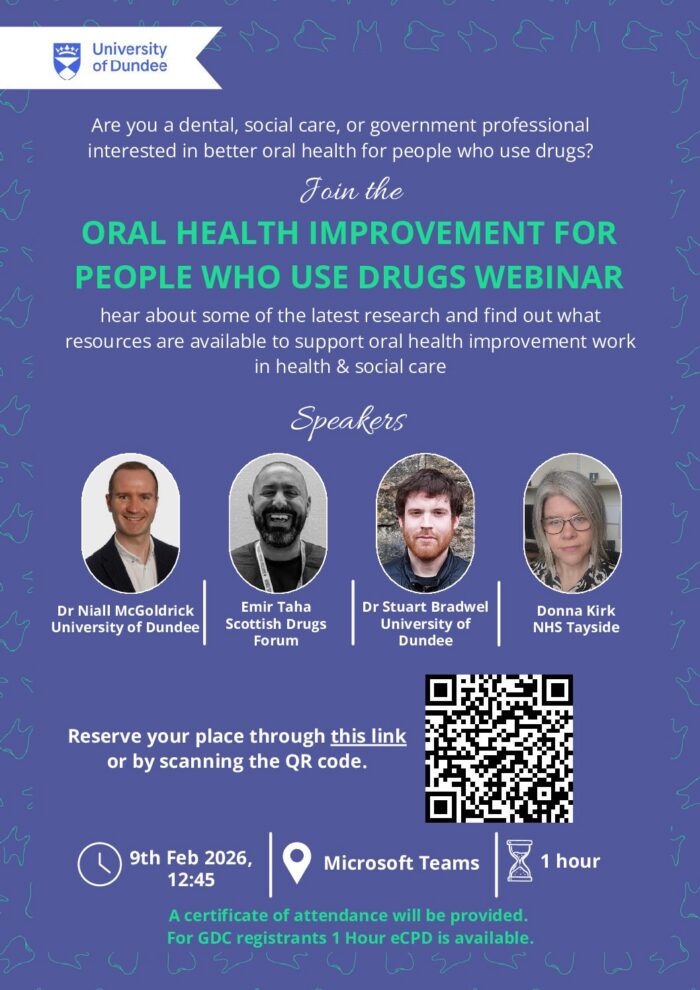
To support with the dissemination of these resources, the University of Dundee has arranged a webinar – Oral Health Improvement for People who Use Drugs – on Monday 9 February, at 12:45-13:45. A certificate of attendance will be provided for every attendee and, for GDC registrants, one hour of eCPD is available.
“I would like to put on record my thanks to everyone involved in developing these excellent resources,” said the CDO, “from the project team, to the volunteers who helped ensure that the resources reflect the realities and lived experiences of people who use or have previously used drugs.
“Reducing the harms of drugs is a key priority for the Scottish Government, as is our commitment to sustaining and improving NHS dental services. I therefore commend to you these resources and encourage you to promote their uptake amongst your colleagues.”
Comments are closed here.