

New cleft resource
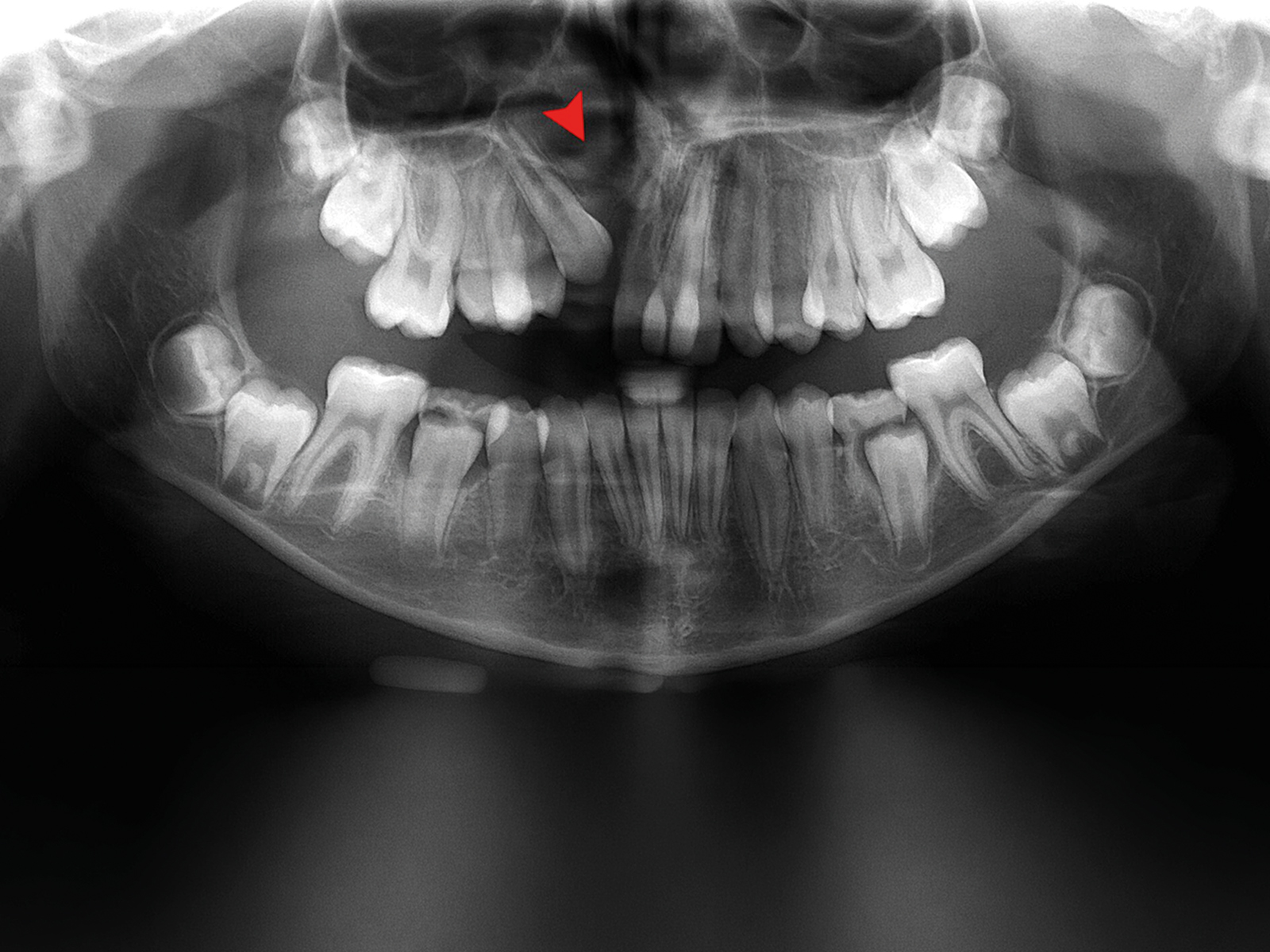
Panorex X-ray showing defect – red arrow – in the alveolus with maxillary canine tooth erupting into the cleft at age 13 (Picture: Creative Commons)
A new national resource, entitled Cleft Lip and/or Palate: A Practical Guide for Primary Dental Care Teams, has been launched by the British Society of Paediatric Dentistry (BSPD) to support dental care teams in caring for children, young people and adults born with a cleft lip and/or palate.
This initiative follows an approach by Cleft Lip and Palate Action (CLAPA) to BSPD, which presented its Cleft Dental Crisis campaign to the Society and suggested that families struggle to find dentists who understand cleft and feel confident providing care. Feedback from clinical networks points the same way, showing variation in confidence among dental teams and families unsure what to expect from their local dentist.
Cleft lip and/or palate is one of the most common congenital craniofacial conditions caused by incomplete fusion of the lip, alveolus and/or palate in early pregnancy. Children born with a cleft usually require long-term multidisciplinary care, including surgery, speech and language therapy, orthodontics and specialist dentistry.
the guide will support more joined-up care and clearer communication for patients and families.
Dr Oosh Devalia OBE
The primary dental care team is the local constant throughout, providing preventive care, monitoring dental development and supporting timely referral and communication with specialist cleft services.
Children with a cleft should be regarded as high risk for dental caries from infancy, and evidence shows they experience higher levels of caries than their peers even in the primary dentition. Early, effective prevention has a significant impact on long-term oral health and on later orthodontic treatment and surgical outcomes.
Structured by age, the guide sets out what the primary dental care team should prioritise at each stage, and what specialist cleft and multidisciplinary team services will usually be doing. This reflects the UK model of cleft care and clarifies how primary care contributes to the overall treatment journey.
The resource has been funded by BSPD and developed by a short-life working group with the Cleft Clinical Excellence Networks (CENs) within the Craniofacial Society of Great Britain and Ireland (CFSGBI), Restorative Dentistry UK (RD-UK) and the British Orthodontic Society (BOS), working in partnership with CLAPA. It is available as a downloadable PDF with quick-reference tools suitable for in-clinic use and for integration into training modules and webinars.
Dr Oosh Devalia OBE, President of BSPD, said: “BSPD is proud to have brought together colleagues from across the cleft and dental communities to develop this important resource. It reflects the expertise, commitment and shared ambition of the collaborative associations who came together to give their expertise and I am sincerely grateful to everyone who contributed their time and insight.
“By setting out the role of the primary dental care team alongside specialist cleft services at each stage of care, the guide will support more joined-up care and clearer communication for patients and families. We hope it will become a useful, accessible resource for dental teams across the UK.”
Claire Cunniffe, Chief Executive of CLAPA, said: “During our End the Cleft Dental Crisis campaign, the cleft community told us about the difficulties they face finding dentists who understand their cleft and feel confident providing care. We approached BSPD because we wanted to work with the dental profession to develop a practical response to these experiences.
“This guide is an important step towards giving dental teams the knowledge and confidence to provide consistent, high-quality care throughout a person’s life.
“We are incredibly grateful to BSPD for leading this work, and to the Craniofacial Society of Great Britain and Ireland, the Cleft Clinical Excellence Networks, Restorative Dentistry UK and the British Orthodontic Society for working alongside us to produce this valuable resource.
“We are proud of what this collaboration has achieved and hope the guide will make a real difference to dental professionals, and for people born with a cleft and their families across the UK.”
References
- End the Cleft Dental Crisis – Clapa.com