
A sustainability journey

Image: unsplash.com / @hansjurgen007
Over the last two decades, Childsmile has become one of Scotland’s most recognised public health programmes, improving oral health outcomes for hundreds of thousands of children while helping to reduce inequalities. More recently, it has faced a new challenge: how can a national prevention programme deliver health improvement while also responding to the wider sustainability ambitions of NHS Scotland?
Childsmile’s sustainability journey began with a simple recognition. Healthcare systems contribute to climate change, with the NHS responsible for approximately 5% of the UK’s total Greenhouse Gas emissions (Sustainable Development Unit, 2016).
Rather than viewing sustainability as a bolt-on, Childsmile sees it as an extension of the programme’s core purpose. Prevention, after all, is inherently sustainable. A child who avoids dental decay avoids treatment, travel, resources and costs later in life. This connection between oral health improvement and environmental sustainability has become the central theme of Childsmile’s work and has been recognised as a case study of prevention and sustainability by Public Health Scotland.
This experience demonstrated that environmental gains can be made… across Scotland’s remote and rural areas in particular
Starting with a framework
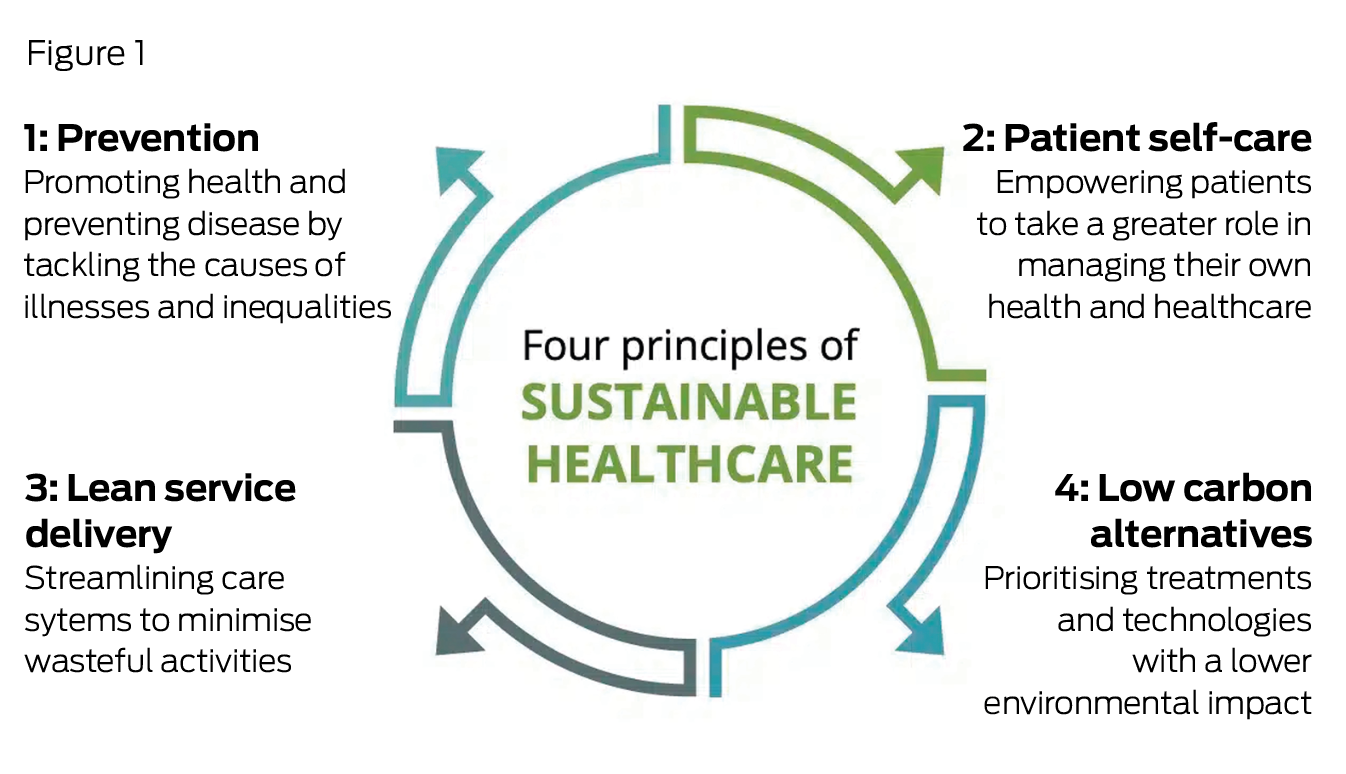
The big question all services will face at some point is: “Where do we start?” The news on our televisions tells us the world is either on fire or in flood and it can feel a little futile wrestling with ‘local’ challenges. Childsmile found the four principles of sustainable healthcare to be a great starting point for helping to identify a way forward. The Centre for Sustainable Healthcare provides a framework of principles for developing policy and actions to support sustainable health service delivery (Figure 1).
Importantly, Childsmile recognised early on that success would depend on collaboration between local Childsmile teams, NHS Boards, procurement colleagues and delivery partners across Scotland. The establishment of a dedicated sustainability group helped provide leadership and coordination for this work.
Success 1: reducing travel through digital working
Transport is one of the single biggest contributors to the NHS carbon footprint and one of the earliest and most measurable successes has been the reduction in national travel.
Childsmile embraced Microsoft Teams as the default platform for strategic and planning meetings across national and regional networks. By reducing the need for staff to travel to central locations, Childsmile was able to significantly decrease travel-related emissions while maintaining engagement and collaboration.
The reduction in distance travelled in one year was just under 18,000km. This is the equivalent of flying from Edinburgh to Sydney, Australia, and saves 3,600kg of equivalent carbon emissions (CO2e); equal to the weight of seven adult polar bears.
This experience demonstrated that environmental gains can often coincide with operational benefits, including reduced travel time, lower costs and improved accessibility for staff working across Scotland’s remote and rural areas in particular.
Success 2: reducing use of paper-based publications
Childsmile undertook a review of all nationally published print resources with a view to reducing our paper-based footprint. Published assets were reviewed by a national subject expert group which provided recommendations on digitisation and withdrawal from use. This led to a reduction in paper use which has been sustained year-on-year.
Making these changes saves Childsmile around 2,600Kg CO2e each year, the equivalent of six adult Highland cows. If all the paper no longer used was laid out side by side, it would cover an area the same size as four Hampden Park football pitches.
Success 3: tackling single-use products
Childsmile teams across Scotland have explored alternatives to the routine use of disposable mirrors during fluoride varnish application. By the end of 2024, Childsmile was using around 71,000 fewer single-use mirrors compared with before the Childsmile sustainability strategy was implemented. This highlights how relatively small changes, when implemented at scale across a national programme, can generate measurable change.
Success 4: driving innovation in procurement
Procurement has also become an important focus. Childsmile continues to work with National Procurement (PSDS) to explore more sustainable options for equipment with suppliers. One example is the ongoing development of a locally sourced free-flow drinking cup as an alternative to shipping tens of thousands of items from overseas.
The programme has also worked with suppliers to develop cost-effective, single-mould, fully recyclable toothpaste tubes. Toothpaste tubes are amongst the most challenging oral care items to recycle as a result of traditional laminated structures containing so many mixed materials.
The new recyclable toothpaste tubes were introduced in 2026 and will be used in all supervised toothbrushing programmes and oral health packs provided for use in family homes. The plastic used can be disposed of in kerbside recycling or as part of NHS plastic recycling waste streams.
Sustainability is not limited to what happens when products reach children and families. Increasing attention is now being given to how products are manufactured, transported, packaged and disposed of.
Success 5: demonstrating that prevention is sustainable
The strongest sustainability argument for Childsmile may ultimately lie with the very aims of the programme itself.
Evidence shows that supervised toothbrushing and other Childsmile interventions improve oral health outcomes and reduce dental disease. Research also shows that the carbon savings associated with preventing disease outweigh the emissions generated by implementing supervised toothbrushing, with emissions savings due to reducing need for treatment more than four times greater than programme emissions.
This is a powerful reminder that preventing tooth decay, and avoiding environmentally costly treatment, is one of the most impactful sustainable measures Childsmile has delivered.
Setbacks and challenges
While progress has been significant, the journey has not been without difficulties.
Toothbrush recycling continues to be an ambition of the Childsmile programme but has been a significant challenge. Plastic toothbrushes are recyclable in principle but, because of mixed materials in the head, they are not recyclable at home and industrial processes struggle to perform the task in an economically sustainable manner.
The scope, scale and reach of the Childsmile Toothbrushing Programme has been crucial in improving child oral health
over the last 20 years. Whilst more environmentally friendly alternatives are available, they have not been deliverable within
the Childsmile budget.
Short-lived recycling services have been established in the last couple of years, firstly with Terracycle and laterally through a supplier to NHS Scotland. On both occasions, the service stopped due to challenges they faced with recycling oral care products.
The next-best alternative involves used toothbrushes being included in black bag waste which should be incinerated to generate heat or electricity as part of waste-to-energy initiatives. However, incineration capacity in Scotland is challenging and, in any case, inclusion of plastics in incineration feedstock results increased charges to NHS Scotland due to inclusion of recyclable material. Finding an economically viable solution to recycling used toothbrushes is challenging. Although this presents difficulties, Childsmile continues to work with their national waste management colleagues in PSDS to find a long term, sustainable, solution.
By combining environmental action with its long-standing commitment to improving children’s oral health, Childsmile is demonstrating that the future of sustainable healthcare is not simply about doing less harm. It is about delivering better outcomes for people, communities and the planet at the same time.
Peter King is the Childsmile Programme Manager
Comments are closed here.