

Digital dentistry: part one
Learning dental clinical skills with touch technologies and simulations
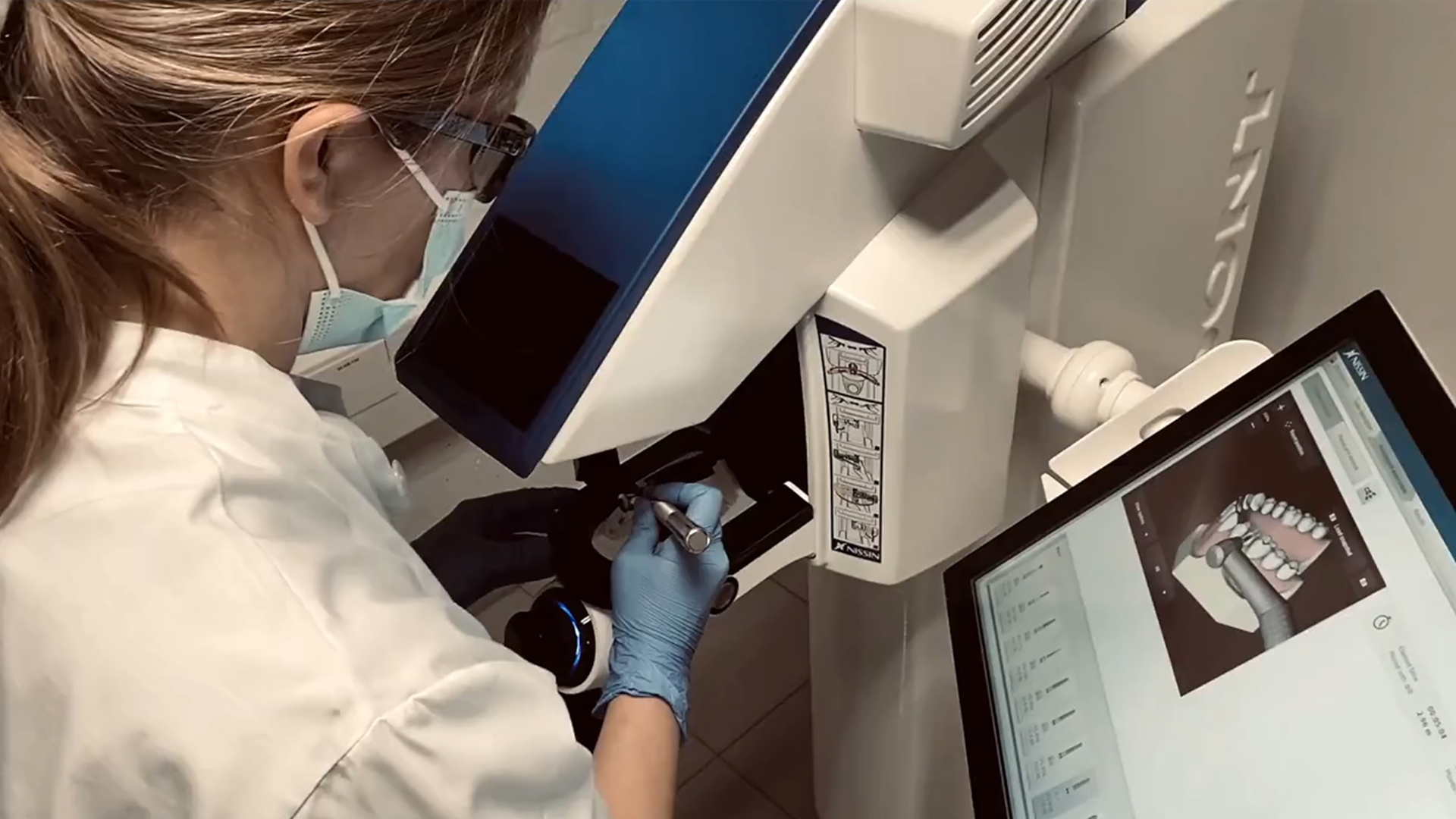
What do we mean by digital dentistry?
The rapidly growing number of new technologies being produced in the health sciences and those already embedded into higher education courses are providing new opportunities for dental educators, clinicians, trainers and practitioners.
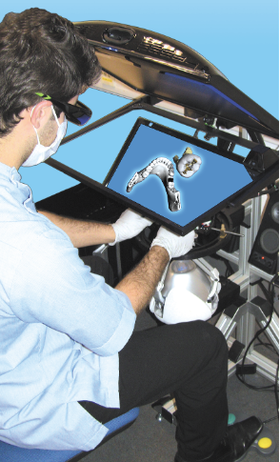
Collectively, the use of these technologies in dentistry is frequently called ‘digital dentistry’ which includes virtual simulators using haptic (sense of touch) interfaces such as the one shown below (Figure 1).
Here, we see a year 1 BDS dental student using the award-winning hapTEL system designed in 2007-9, where the learner is holding a dental drill in his hand and operating the ‘drilling’ procedure using a dental foot pedal1, 2.
He can ‘feel’ the resistance of the tooth through a haptic device while trying to create a cavity in a tooth with decayed tissue. The simulator has a second screen on the side (not shown) on which the student can select the type of cavity, instrument, speed of drill and magnification of the image, and keep a record of the operations etc.
Alongside virtual haptic simulators, other digital resources found in dental schools and training centres include computer-based devices such as 3-D scanners and printers, CAD-CAM milling equipment, radiography and computer implant dentistry. As these become part of the dentist’s resources for treating patients, so their uptake in dental education is also increasing.
Ten years of extensive research using the hapTEL system with more than 1,200 students at King’s College London showed that it can provide equally effective training as the traditional system, with the additional advantages of costing less and providing immediate documented individualised feedback to every student1.
Another well-known haptic simulator is the Simodont system (shown in Figure 2), which was developed by the ACTA team in the University of Amsterdam during the same period.
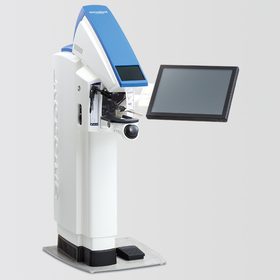
Although the design of these two systems is different, the educational purposes are similar; each was developed to enable learners to perform common dental procedures, such as the removal of caries from a single tooth or a tooth embedded in a jaw.
All recent systems include many other dental procedures relevant to orthodontics, prosthodontics, oral and maxillofacial surgery etc. These simulators also include, for novices, non-dental specific tasks, such as drilling into a ‘3D block’.
Even with the now more realistic up-to-date virtual dental work-stations such as SIMtoCARE (shown in Figure 3) the basic operation of the learner is to hold a device in one hand, and sometimes the mirror in the other, and apply force and precision to conduct a procedure which can be controlled by the use of the foot pedal and the hand-manipulation of the user.
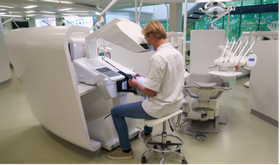
The SIMtoCARE simulator shown here has two screens, one of which is a control panel at which the learner can select what kind of tooth/jaw etc., he or she might choose to operate on, with many different instruments, speeds, magnification etc. These have now been installed in more than 30 dental schools worldwide with many having suites of eight or more being used for the undergraduate and postgraduate programmes.
With modifications, these systems can now also be used for dental hygienists, medical and nurse education on a wide variety of procedures from suturing to injections. Further technological developments provide the opportunity to broaden these application to other fields and contexts, such as patient rehabilitation after strokes, improving motor skills with feedback and monitoring progression in performance and understanding.
Challenges in learning dental skills for the novice student
The first practical difficulty dental students encounter is learning to hold the instruments correctly and ergonomically positioning the patient. Novices often use too much pressure for too long, with the concomitant removal of too much dental tissue. Using haptic simulators allows them to go through this process repeatedly without destroying plastic or natural extracted teeth, which are in short supply.
The students can learn clinical skills to prepare carious virtual teeth and later to transfer these skills into the real clinical environment. The student and tutor can play back a video to examine the technique and to see how much decayed versus healthy tooth they had removed.
As one student said: “When you first come into dentistry everything is very alien to you; the way you position your hand, the tiny movements that you need to perform procedures. These are difficult to achieve. The hapTEL system allows you to repeat a task over and over again; it gets ingrained into your muscle memory and improves your manual dexterity.”
Assessing what students are learning
A major part of any teaching and learning programme or professional development course is how to assess the learning outcomes and the acquisition of skills. Previous world-renowned research by Black and Wiliam3 shows that the most effective basis for improving learning through assessment is by formative assessment, whereby the learner is challenged to express their ideas and understanding and discuss those with the teacher, and by getting feedback during the learning activity.
In healthcare education, a large proportion of the assessment is conducted through either observation of practice e.g., in clinics or in the Phantom Head Lab, or through assessing assigned clinical competence tasks in a simulated clinical environment against a set of criteria e.g., the Objective Structured Clinical Examinations (OSCEs). With the former approach, the students are given feedback but usually on their level of performance with limited detail, whereas in the latter assessments, these are summative and take place after months of teaching and learning.
The advantage of using virtual dental simulators instead of the traditional phantom head is the ongoing and immediate formative feedback provided to the learner. For each stage in the students’ operation, they can see how well they have done and where they can improve within minutes of the activity. Furthermore, they learn how to evaluate their own learning which provides a foundation for learning strategies which makes them better learners for the rest of their lives.
An extensive review conducted in 2021 by 39 European dental educators/researchers investigating the abundance of simulation technologies available to support the delivery of dental education concluded that “there is a need to empirically scrutinise today’s digital simulators in the context of dental training and education, to identify their potential utility as pedagogical tools and to inform their future design improvement”4, p20.
Guidelines commissioned for Health Education England in 2023, disseminated to all dental education and training establishments, provide further extensive research evidence of how digital dentistry has enhanced teaching and learning across the field in different education and training settings1.
Today’s challenges
In 2026, at every international dental conference the latest haptic simulators are on display showing how they can enhance teaching, learning and training. This expansion in digital dentistry use is not only due to innovative educators adopting them but also because of the increasing influence of students themselves.
Despite many universities still focusing mainly on traditional teaching, the increasing number of students entering Higher Education and the explosion of IT technologies in society and industry has led to universities needing to develop new ways of teaching, and thereby new ways for students’ learning. This has led to growing expectations that traditional learning and teaching systems will need to adapt and change in universities to keep up with students’ expectations and benefit from the opportunities which technology enhanced learning (TEL) can offer to teaching and learning. An analysis of the impact of TEL on higher education establishments by Diana Laurillard5, over more than three decades, shows that teachers in higher education have had to become more professional in their approach to teaching, matching their professionalism in research to their strategies for teaching, and the advantages of computer technology has resulted in a pedagogical shift in higher education.
The reality: how widely used are haptic simulators in dentistry?
Despite all the positive evidence available to date and the relentless march of digital dentistry, including simulators, over the past 50 years many have remained infrequently used and are still not prominent in the dental curricula. At dental conferences, how many posters do we see showing integrated uses of haptic simulators in the undergraduate curriculum? At the American Dental Education conference (ADEA2026) in Montréal, in March, very few such posters were about digital dentistry and even fewer exhibits showed the latest versions of haptic simulators.
The explanations for the slower than expected uptake and limited use can be provided by many studies in other areas of Higher Education research, particularly through the extensive work of Noel Entwistle, who spent years investigating the factors which influence students’ learning in Higher Education. As an outcome from his investigations, he produced a model (Figure 4) which shows all the factors which can directly or indirectly affect the quality of students’ learning.
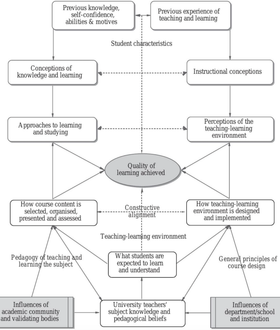
This has been used by many researchers since to help us understand that innovations in teaching and learning have many influencing factors on the path to full integration1,6. If we look at this framework, we can see that even if the teaching and learning environment, i.e. virtual haptic simulators and other digital dentistry devices, has been shown to be beneficial to students’ learning, the quality of the learning achieved will also depend upon how the course content is selected, organised, presented and assessed.
All too often, dental schools do not have enough devices for all students to have equal access or to use them frequently enough to benefit their learning. In such situations, the uses become unsupervised optional extras are, thereby, seen as less important than all the other learning activities the students are required to follow. Furthermore, how the teaching and learning environment is designed and implemented will depend upon the influences of the dental school/department and so on. So, the reasons that virtual dental simulators might not yet be used regularly or even at all in some dental schools include:
- The use of these simulators must be included in the planning of the whole teaching, learning and assessment programme from the start.
- Those who decide and plan a dental course or training programme need to understand how these devices can complement other teaching resources and which skills and concepts will be learnt.
- Those dental teachers assigned to using these devices need to know how they can be used to best educate the learners and how to organise the learners and the teaching and learning sessions accordingly.
- Equal importance needs to be given to the uses of the virtual haptic simulators as to all the other practical clinical sessions.
- Finally, assessing what the students are learning and providing feedback should be given the same weight and importance as any other learning activity on the programme.
These are just a few of the requirements known to be important to the successful uptake and integration of digital dentistry for education and training. If we are to harness these powerful teaching and learning devices to enhance the skills of our future dentists, then these strategies need to take centre stage in every dental school and training centre.
Author
Professor Margaret J. Cox is Emeritus Professor of Information Technology in Education at King’s College London and Honorary Professor at the University of Portsmouth.
References
- Cox, M.J., Kerr, K., Louca, C., Barber, S., Haywood-Hull, J. & Hallissey. B. Guidelines for Using Simulations, Haptics and Digital Dentistry in Education. Health Education England. Published by University of Portsmouth (2023).
- Tse, B., Harwin, W., Barrow, A., Quinn, B., San Diego, J., & Cox, M. Design and Development of a Haptic Dental Training System – hapTEL. In Haptics: Generating and Perceiving Tangible Sensations, Lecture Notes in Computer Science (Vol. 6192, pp. 101-108). Springer Berlin / Heidelberg. 2010
- Black, P. & Wiliam, D. Assessment and Classroom learning. Assessment in Education: Principles, Policy & Practice. 5 (1). 7-74. (1998).
- Sheppard, W. …Cox, M.J. et al., (39 authors). Simulation-Based Dental Education: An International Consensus Report. European Journal of Dental Education July 2021
- Laurillard, D. Rethinking university teaching: A conversational framework for the effective use of learning technologies. Routledge, London. (2013).
- Entwistle, N. & Peterson, E. Conceptions of learning and knowledge in higher education: relationships with study behaviour and influences of learning environments. International Journal of Educational Research. 41 (6), 407-428. (2004).
Comments are closed here.