

Celebrating 20 years of Childsmile
Scotland’s national oral health improvement programme Childsmile turns 20 and has halved tooth decay among children.
The Childsmile Programme is celebrating its 20th birthday this year. In 2006, the programme began as a series of demonstration projects that grew into Scotland’s national oral health improvement programme for children, as we know it today.
The programme began its year of celebration with a reception at the Scottish Parliament on 26 February. Jenni Minto MSP, the Minister for Public Health and Women’s Health, congratulated those behind the programme and shared her admiration for what the service has achieved and its plans for the future.
Joe FitzPatrick MSP was host for the evening and offered his thanks and best wishes, telling the audience: “The impact Childsmile has had on Scotland’s oral health cannot be overstated. Between 2006 and 2020, the Childsmile programme halved tooth decay amongst children.
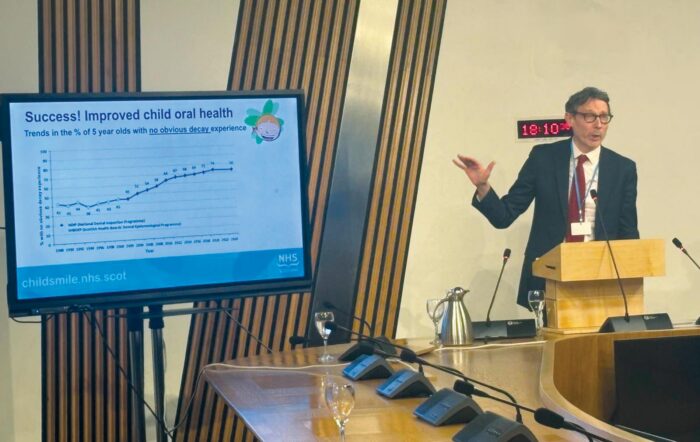
The percentage of five-year-old children with dental caries has reduced to around 25%
“This, of course, generates significant cost savings for our health service, as well as creating a long, lasting, legacy for Scotland’s children. Childsmile’s incredible collaboration is fundamental to its success.”
After the parliamentary reception, Mr FitzPatrick raised a motion in the Scottish Parliament asking that the parliament congratulate Childsmile on the significant achievements of Scotland’s national oral health improvement programme on its 20th anniversary.
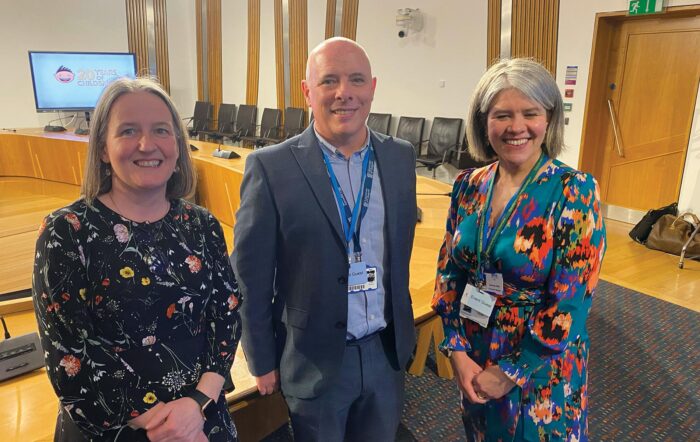
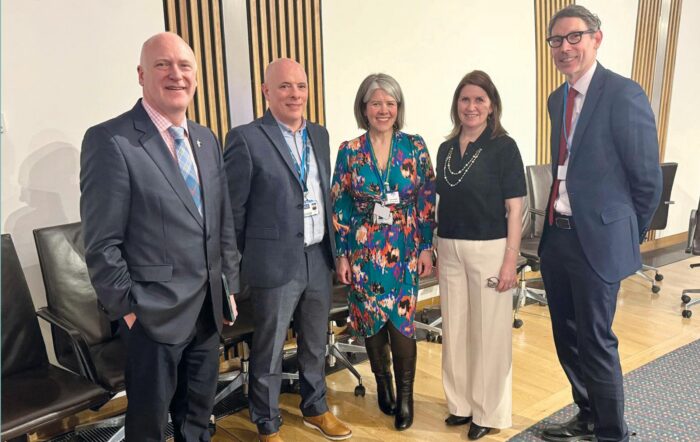
The parliamentary reception was also host to a range of partners who have supported the delivery of Childsmile over the decades. The programme owes much of its success to collaborative working and representatives from education, health visiting, general dental services and wider NHS and university services were on hand to share their experience and knowledge with other guests. This included stakeholders key to delivering the multidisciplinary and multidimensional facets of the programme, and other members of the Scottish Parliament.
The Childsmile Executive – the strategic and operational oversight group of the programme, comprising David Conway, Jennifer Rodgers, Peter King and Donna Kirk – were available to speak about the programme and its continuing delivery, as well as the path for the future.
Among the attendees were a number of former Chief Dental Officers (CDOs), programme directors and managers, all of whom made significant contributions to the development, implementation and ongoing delivery of Childsmile over the last 20 years.
The group included Gillian Leslie, Scotland’s new CDO, who shared her thoughts on Childsmile. “As a practice owner and dentist, I delivered Childsmile to children in my practice for many years. It was extremely rewarding to see first-hand the positive impact of the programme on our young people’s oral health, and to have a small role in achieving this.
“We are now living in a generation where, for many, looking after your teeth is the norm from a young age and, as the mouth is the gateway to the body, this will undoubtedly support us in developing healthier, happier adults.
“In my new role as Chief Dental Officer, I am determined that we continue this positive progress, which has seen a huge long-term improvement in children’s oral health and a corresponding reduction in child oral health inequality.
“I recognise there is more work to do, particularly to target our most vulnerable children, and the Scottish Government will continue to support the programme to tackle inequalities. I would like to place on record my thanks and appreciation to everyone involved in delivering Childsmile over the last 20 years.”
A feature of the longevity and impact of the Childsmile programme has been the support of successive CDOs and strong political cross-party support from the Scottish Government. During the lifetime of Childsmile, the programme has had the support of five different governments.
Childsmile programme Co-Directors Jennifer Rodgers and David Conway shared the health outcomes of the programme over the past two decades. The percentage of five year-old children with dental caries has reduced from around 60% at the outset of Childsmile to around 25% at the last measure. A similar pattern can be seen in older children; around one in two children had dental caries 20 years ago compared with one in five in 2024. These figures demonstrate the impact Childsmile has had on reducing tooth decay amongst Scotland’s children over the last 20 years.
This improvement in health outcomes has the additional benefit of demonstrating Childsmile as a good example of preventive spend. Using the Childsmile nursery supervised toothbrushing programme as an example, we can see that for a cost of approximately £1.8 million per annum, we create savings from treatments avoided of around £4.7 million. With treatment costs around 2.5 times the cost of implementation, Childsmile is a good example of a financially sustainable preventive service.
Childsmile has also had an impact beyond Scotland’s borders, with elements of the Childsmile approach adopted and adapted across the world, including in Australia, Chile, Malawi, Saudi Arabia and Romania.
The Childsmile programme plans to further refine and optimise its commitment to the supervised toothbrushing programme in schools and nurseries, alongside community engagement work with health visitors supporting children in early years, from the most socioeconomically deprived backgrounds, in the family home and delivering preventive advice and treatments in general dental services. While great progress has been made over the last 20 years, the Childsmile programme will seek to evolve and further improve as it aims to reduce oral health inequalities among children.
You can find out more about Childsmile on their NHS.scot portal.
Comments are closed here.