
Providing actionable insights
The Oral Health Summit in Edinburgh reinforced the importance of evidence-based practice.
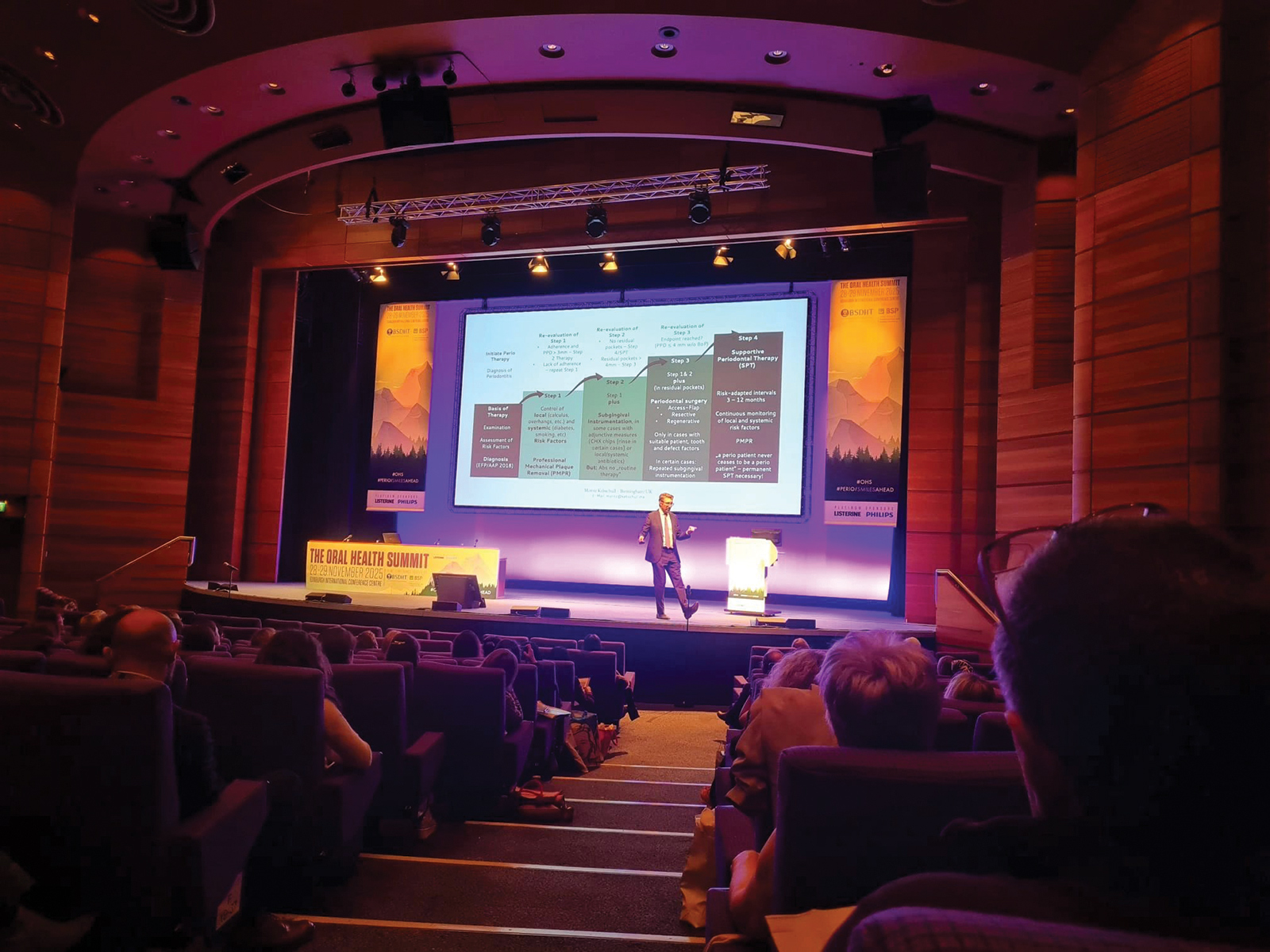
The summit featured global leaders in periodontics and implantology including Professor Moritiz Kebschull
The Oral Health Summit, held in Edinburgh last November, combined the perspectives of the British Society of Periodontology (BSP), the British Society of Dental Hygiene and Therapy (BSDHT) and the British Society for Oral and Dental Research (BSODR), successfully fostering a holistic approach to oral health.
The summit reinforced the importance of evidence-based practice and provided dental professionals with actionable insights to improve patient outcomes in periodontics and beyond. Led by the BSP President Professor Nicola West, the event was designed as a multidisciplinary ‘super-meeting’, bringing together periodontists, dental hygienists, therapists and researchers.
The summit focused on bridging the gap between cutting-edge laboratory research and daily clinical practice, with a specific emphasis on periodontology and implant dentistry.
In my work, I have explored an approach to working with patients to modify their oral health behaviours building on psychological theories of behaviour change
Professor Newton
Its programme was structured around the latest innovations in oral health. Themes included the perio-systemic connection exploring the link between gum disease and wider systemic health, regenerative techniques, advanced surgical methods to restore lost periodontal tissue and the microbiome and biofilms in terms of understanding the bacterial ecosystems of the mouth and how they influence disease management.
Additional themes covered innovations in implant dentistry (assessing how material choices and biological factors affect long-term implant success) and risk profiling (moving toward personalised patient care based on individual risk factors).
Professor West told the audience: “I am so excited to welcome you all to Edinburgh and truly grateful that so many of our members are supporting this special conference.
“Conferences are a wonderful opportunity to reconnect, share knowledge and learn together. Life gets very busy and it’s essential that we take time to pause, reflect and consider how we can continue to grow, both personally and professionally.
“No matter what stage we are at in our careers, there is always something new to learn, and I’m confident you will take away valuable insights and skills to bring back to your practice.”
Among the speakers was Iain Chapple, Professor of Periodontology at the University of Birmingham. Professor Chapple presented the first lecture of the summit, The global burden of oral diseases – what’s the fuss?
He started by pointing out that more than 3.65bn people worldwide suffer from caries and severe periodontitis, according to the Global Burden of Disease Study 2021.
That is one billion more than that suffer from cardiovascular disease, diabetes, chronic respiratory diseases, cancer and mental health disorders combined. Professor Chapple said: “This somewhat embarrassing statistic was, in part, a major driver of the World Health Assembly’s Global Resolution on Oral Health in 2021, followed by the World Health Organization’s Global Oral Health Status Report in 2022 and the Global Strategy and Action Plan on Oral Health 2023-2030, which informed the WHO Bangkok Declaration in 2024 that declared: “There is no health without oral health”.
On 28 November 2024 the United Nations 4th High-Level Meeting was held on non-communicable diseases (NCDs) and included oral diseases for the first time and “just this week,” said Professor Chapple, “the UN General Assembly adopted the UN political declaration on NCDs and mental health disorders and explicitly and robustly included oral health throughout the declaration.”
The UN member states recognise that oral diseases impose a major health and economic burden across the course of people’s lives; causing pain, disability and death, while being largely preventable and closely linked with other NCDs, he said. Professor Chapple urged members to advocate for oral diseases at every possible opportunity, stating that “now is the time to start ‘walking the walk and not just talking the talk’.
“This call to action appears well founded, as the European Commission Safe Hearts Plan, was published yesterday and flags oral health within the context of healthy dietary habits. It states that dietary habits also influence oral health which is in turn vital element of cardiovascular health.”
Professor Chapple went on to explain the modelling behind the article Time to take gum disease seriously: The societal and economic impact of periodontitis published by The Economist which demonstrated that enacting preventative care models for periodontitis could save between €7.8Bn and €36Bn over a decade across a range of European economies. He presented data from the most recent Economist Impact modelling of diabetes related healthcare costs in periodontitis patients across 40 countries of the world, amounting to $1 trillion over the next decade. Treating periodontitis could help prevent 57 million cases of type-2 diabetes (T2D) over a decade and yield an estimated economic benefit of US$162.8bn, arising from both reduced healthcare expenditure and increased productivity, with the greatest benefit for the lowest income groups within each country.
The remainder of his presentation discussed health inequalities and greater linkage between oral healthcare and medical teams in collaboratively managing NCDs. He showed pilot data demonstrating models for early case detection of hypertension in high street dental practices, and for T2D, successfully undertaken by dental teams. He called for an end to the 1960s ‘repair model’ of dental funding based upon ‘widget counting’ to one that focuses on prevention and patient reported outcomes of health and wellbeing.
Tim Newton, Professor of Psychology as Applied to Dentistry, King’s College London, told the summit: “The maintenance of good oral health is critically dependent on behaviour. Often, for many reasons, our patients’ oral health behaviours are not optimal for their individual health needs. Patients can ensure good oral health by changing their own behaviour to ensure that they are keeping their teeth clean, preventing the harm from tobacco use, and reducing their sugar intake.
“Dental healthcare practitioners should consider their own behaviour in terms of whether they are using the best possible approach to supporting their patients to change and maintain their good oral health related behaviours. In my work, I have explored an approach to working with patients to modify their oral health behaviours building on psychological theories of behaviour change,” said Professor Newton.
“Underpinning the approach is a foundation of a mutually respectful ongoing relationship between the patient and healthcare team. The approach has four stages, described in turn: Goal Setting, Planning, Self-Monitoring and Perseverance (GPS-P). This approach can also be used by healthcare professionals to consider adapting their own behaviour,” he said.
Professor Newton said that goal setting involves agreeing a goal, preferably one that is achievable
in the short term and can build to a bigger goal over time; for example, agreeing a goal of using interdental brushes once a week, that can then grow to more times per week. Planning, he said, is the process where a person decides how, when and where the behaviour will occur.
“It helps if you form a mental image of yourself doing the behaviour and think about what you will need, in terms of resources and time,” he said. “We can give ourselves feedback about how well behaviour change is going through monitoring our own behaviour – keeping a record of how often we have managed to fulfil our goal.
“This might also highlight challenges, like busy days or times when you are just too tired for the behaviour. Finally, by repeating a behaviour, eventually it will become habitual through perseverance. On average, it takes 66 days of a repeated behaviour before it becomes habitual.
“It is important not to forget that behaviour occurs within a societal and cultural context which may make healthy behaviours more, or less, easy to adopt. Dental healthcare professionals should consider advocating for changes – legislation, taxation, provision of services – which make healthy choices easier. For example, outlawing smoking in public spaces, a sugar tax and subsidising toothpaste and other oral health essentials. Every voice counts.”
Beyond lectures, the summit offered hands-on learning opportunities sponsored by major industry partners, including EMS, NSK, Geistlich, Straumann and Hu-Friedy). These sessions allowed delegates to practice:
- Advanced instrumentation techniques.
- Use of regenerative materials in practice.
- Guided Biofilm Therapy (GBT) and modern airflow technologies.
Post-summit, Professor West said: “It was wonderful to bring our community together under one roof, to enjoy the scientific programme and to share our collective passion for periodontology. We have been overwhelmed by the amount of positive feedback received.”
The summit in summary
The opening day focused on the synergy between academia and the clinic.
- Innovations in Periodontology: A joint session with the British Society for Oral and Dental Research where Professor Nick Jakubovics (Editor of the Journal of Dental Research) discussed oral biofilms.
- Clinical Applications: Dr Jeanie Suvan presented on the evolution of non-surgical periodontal therapy, while Professor Robert Hill provided critical insights into the efficacy of modern toothpastes.
- Sir Wilfred Fish Research Prize: The afternoon featured presentations of high-level research, alongside practical lectures for Dental Care Professionals (DCPs). Dr. Ian Dunn’s session on “managing the non-responding patient” was a particular highlight for clinicians dealing with complex cases.
Days two and three featured global leaders in periodontics and implantology:
- Keynote speakers: The event secured world-class clinicians including Otto Zuhr, Giulio Rasperini, István Urban, and Anton Sculean, who presented on advanced surgical and regenerative strategies.
- A Pint of Science: A unique, interactive debate format featuring Professors Mike Curtis, Phil Marsh and Iain Chapple. This session delved into the complexities of the oral microbiome in a lively, conversational setting.
- Perio-Ortho Interface: Discussions led by Professor Virginie Monnet-Corti and Dr Alex Pollard focused on optimising outcomes when periodontal and orthodontic treatments overlap.
The summit also offered hands-on learning opportunities sponsored by major industry partners (EMS, NSK, Geistlich, Straumann and Hu-Friedy):
- Advanced instrumentation techniques.
- Use of regenerative materials in practice.
- Guided Biofilm Therapy (GBT) and modern airflow technologies.
Comments are closed here.